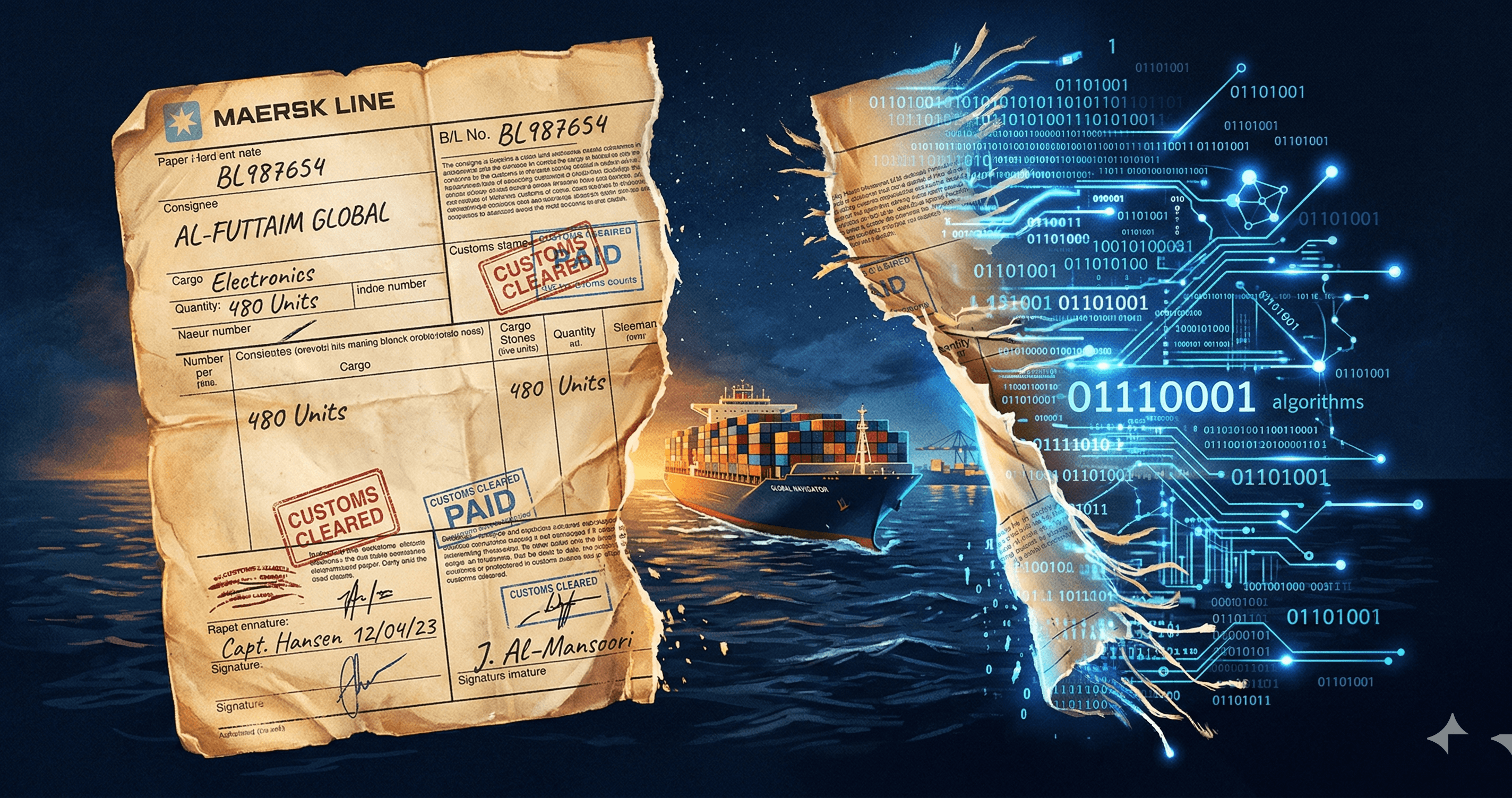
Electronic Bills of Lading: The Reality Check
At GTR Asia in Singapore last November, I counted seven panels that included the phrase "electronic bill of lading." I then asked every trade finance banker I met the same question: how many eBLs did your bank process in 2025?
The most common answer was a number I could count on one hand.
The DCSA reported in late 2025 that eBL adoption in containerized trade had reached approximately 3.3% of global volume, up from roughly 1.2% in 2022. Progress, but a long way from the "tipping point" that gets declared annually at every industry gathering.
The coordination trap
The technology has been ready for years. A digital bill of lading offers instant transfer, cryptographic verification, no couriers, no lost documents. Every pilot demonstrates clear savings. The DCSA estimates eBLs could save the container shipping industry $6.5 billion annually in direct costs. The pilots work because pilots are designed to work. They involve pre-selected parties on the same platform with pre-agreed workflows.
Production is different. An eBL requires every party in the transaction chain (shipper, carrier, beneficiary's bank, issuing bank, applicant, and often the insurer) on the same platform, or on platforms that can talk to each other. That is a coordination problem across multiple companies, jurisdictions, and technology stacks.
A head of trade finance digitization at a major European bank described the reality: "We onboarded to three eBL platforms. Our top 20 counterparties are spread across all of them, and a few are not on any. For every transaction, I need to check whether this specific combination of carrier, port, and counterparty bank can support electronic. Most of the time, it cannot."
Nine platforms, zero interoperability
The fragmentation is the core problem. Bolero, essDOCS, CargoX, WAVE BL, EdoxOnline, TradeGo, ETS (by GSBN), and several carrier-specific solutions all operate independently. TradeLens, the Maersk-IBM joint venture that was supposed to become the industry standard, shut down in late 2022 after failing to attract rival carriers.
A Bolero eBL cannot be transferred to an essDOCS recipient without converting back to paper. The DCSA published interoperability standards in 2024, but adoption by competing commercial platforms has been slow. Each platform has invested heavily in its own network effects and has limited commercial incentive to make switching seamless.
"We need two or three winners, not nine survivors," said a senior executive at an eBL platform provider, speaking at a BAFT event in late 2025. "The market is not big enough for everyone, and the interoperability problem will not be solved by a standard. It will be solved by consolidation."
The carrier bottleneck
Carriers issue the bill of lading. Without carrier support on a given platform and trade lane, eBLs are not an option regardless of how ready the banks and traders are.
Maersk, MSC, and CMA CGM have all made commitments. Maersk set a target of 100% eBL capability across its network. MSC joined WAVE BL and expanded its platform integrations. But "capability" and "default" are different words doing different work. A trade operations manager at a commodity trading house told tradefinance.news: "The carrier supports eBL on the platform we use, on this specific trade lane, for this type of cargo. Change any one of those variables and we are back to paper."
Bulk shipping, which accounts for a large share of commodity trade finance, lags container shipping significantly. Voyage charter bills of lading, often issued by carrier agents at loading ports with limited digital infrastructure, remain almost entirely paper-based.
The first-mover penalty
The dynamic nobody discusses at conferences is the compliance risk of going first. If a bank is the first in its market to accept eBLs under a letter of credit and a dispute arises (a fraud claim, a legal challenge to the document's validity, an ambiguity in the platform's terms), that bank is exposed. The case law for electronic trade documents is thin. The UK's Electronic Trade Documents Act (2023) and Singapore's MLETR implementation (2026) provide legal frameworks, but few disputes have been tested in court.
A compliance officer at a Gulf-based bank put it directly: "My job is to manage risk. I am not going to be the person who approved an eBL presentation that turns into a loss because a court in the discharge country does not recognize the document. Show me five years of case law, and we will talk."
The incentive structure rewards waiting. So most banks wait.
Where it is working
eBLs have real traction in controlled environments. Intra-group transactions, where both buyer and seller are subsidiaries of the same parent, eliminate the coordination problem entirely. Repeat corridors between established counterparties on the same platform generate consistent volumes. Large commodity traders, Cargill, Bunge, and Trafigura among them, have enough leverage to push counterparties onto specific platforms.
These are genuine wins. But they represent the easiest possible conditions for adoption. Ad hoc transactions with new counterparties across multiple jurisdictions, the scenario that accounts for most global trade, remain overwhelmingly paper.
The realistic timeline
The vendor pitch says eBLs are at a tipping point. The DCSA's own data says 3.3%. Reconciling those two claims requires honesty about what comes next.
Over the next two to three years, adoption will continue growing in controlled corridors and among early-adopter banks. The DCSA's target of 50% eBL adoption by 2030 is ambitious but depends on carrier mandates and platform consolidation that have not yet materialized. Paper will persist on secondary routes, in bulk shipping, and in jurisdictions where legal frameworks lag, for the foreseeable future.
If you are building your digitization strategy, start with your repeat corridors where counterparties are already on compatible platforms. Push your carriers for specific trade lane support. And count your actual eBL transactions this quarter, not the projections from your platform vendor's slide deck.
That number is your reality check.
-- Tamara
Enjoyed this? Get it in your inbox every week.
Sharp trade finance intelligence, delivered free. No spam, no sponsored content.