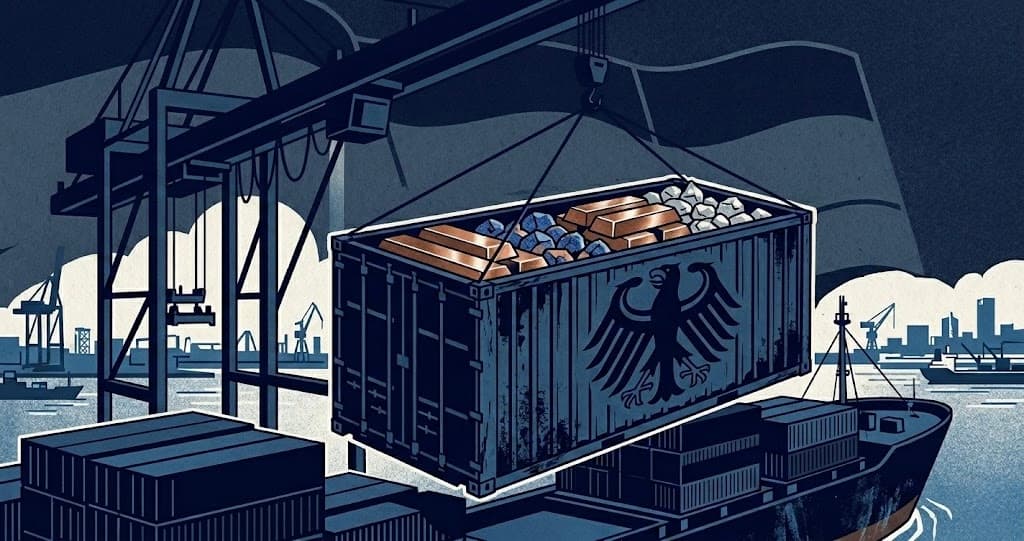
Why Germany Just Backstopped a Commodity Trader for $1.1 Billion
Trafigura announced on February 19 that it had signed a USD 1.1 billion five-year loan agreement, guaranteed by the Federal Republic of Germany through its export credit agency Euler Hermes, to support the long-term supply of critical metals to German industry.
Arranged by Commerzbank AG and syndicated to eight lenders, including JPMorgan, ING, KfW IPEX-Bank, BBVA, Erste Group, Lloyds, and Ceska sporitelna, it is Trafigura's third guaranteed facility with Euler Hermes since 2022, according to the company's press release.
The deal is interesting on its own. But the pattern it represents is more interesting.
Three deals in four years
In October 2022, Trafigura signed a USD 800 million Euler Hermes-backed facility for the supply of non-ferrous metals, primarily copper, committing to deliver up to 500,000 tonnes to German industry over five years. That deal was arranged by Societe Generale.
Two months later, in December 2022, Trafigura closed a USD 3 billion facility, at the time the largest untied loan guarantee Euler Hermes had ever issued, to supply gas to SEFE (the entity formerly known as Gazprom Germania, which Berlin had seized and recapitalized after Russia invaded Ukraine). That deal, arranged by Deutsche Bank, was 1.6x oversubscribed by more than 25 banks. The German government guaranteed 80% of the loan amount. The first gas delivery arrived before the paperwork was signed.
Now this: USD 1.1 billion for critical metals, a category broader than the copper-focused 2022 facility.
Three deals. USD 4.9 billion in total commitments. A single commodity trader, underwritten by a sovereign government.
What is actually happening here
To understand why this matters, you need to understand what "untied" means in ECA financing.
Traditional export credit guarantees are tied to specific exports. A German manufacturer sells turbines to Brazil; Euler Hermes guarantees the buyer's payment. The purpose is to support German exporters. This is what ECAs have done for decades.
Untied guarantees flip the model. Germany is not guaranteeing an export. It is guaranteeing the import of a strategic resource. The government is saying: we need these metals so badly that we will backstop the financing that brings them into the country.
Germany runs its untied programme through the UFK (Ungebundener Finanzkredit) framework. By the end of 2024, total liabilities under the programme had reached EUR 10.9 billion, a figure that has grown rapidly since the Ukraine crisis made resource security a matter of national policy.
Why Germany is doing this
Two words: supply chains.
Germany is the industrial engine of Europe. Its automotive sector is pivoting to electric vehicles. Its energy transition depends on wind turbines, solar panels, and grid-scale storage. Its technology sector needs semiconductors. All of this requires metals: copper, lithium, cobalt, nickel, rare earths, gallium, germanium.
The problem is where those metals come from, and more specifically, who refines them. China refines roughly 73% of the world's cobalt, 68% of its nickel, and produces over 85% of rare earth elements. Beijing has demonstrated a willingness to restrict exports, imposing controls on gallium and germanium in July 2023, graphite in late 2023, and antimony in December 2024.
Germany's response has been multi-layered. The EU Critical Raw Materials Act, which entered into force in May 2024, sets 2030 benchmarks: 10% domestic extraction, 40% domestic processing, 25% recycling of strategic raw materials. No single third country should supply more than 65% of any critical mineral. Germany has also launched its own EUR 1 billion raw materials fund through KfW, taking equity stakes in mining and processing operations globally.
But mines take a decade to develop. Processing plants take years. The immediate gap between Germany's mineral needs and its domestic capacity is enormous. In the short term, the only way to secure supply is to finance the traders who can actually move the physical material, and to guarantee those facilities at the sovereign level so the financing terms make economic sense.
That is what this Trafigura deal represents: the bridge between Germany's long-term mineral strategy and its short-term industrial reality.
The ECA shift
This is not just a Germany story. The broader trend is striking.
According to Berne Union data, global untied ECA financing doubled from USD 22 billion in 2019 to USD 42 billion in 2023. European ECAs that had minimal engagement with commodity traders before the pandemic and the Ukraine crisis are now structuring deals at scale.
Italy's SACE has been particularly aggressive, guaranteeing over EUR 15 billion under its untied "Push" strategy. SACE backed facilities for Gunvor (EUR 400 million for gas/LNG supply to Italy), Mercuria (EUR 500 million for LNG), and Vitol. South Korea's KEXIM renewed a USD 300 million facility with Trafigura in February 2025, specifically for battery metals: cobalt, copper, and lithium. Saudi EXIM signed a USD 800 million critical metals insurance policy with Trafigura in January 2026. The US Export-Import Bank expanded a USD 400 million revolving facility for Trafigura in September 2025.
Deutsche Bank, in a January 2026 research note on export credit agencies, wrote: "The relevance of ECAs today arguably even exceeds their importance during the global financial crisis."
For trade finance practitioners, the implication is clear. ECA-backed commodity facilities are no longer niche transactions handled by a handful of specialist desks. They are becoming a mainstream financing tool, and the structuring, documentation, and compliance requirements that come with sovereign guarantees are becoming essential skills.
What to watch
The Trafigura press release does not specify which critical metals the facility covers. The 2022 deal focused on copper. This one is described as "critical metals," a term that could encompass anything from lithium and cobalt to rare earths. The scope matters, because it signals how broadly Germany is willing to deploy sovereign credit to secure mineral supply chains.
Watch also whether other European governments follow Germany's lead. France has its own critical metals ambitions. The UK has been slower to move. If multiple European sovereigns start backstopping commodity flows at this scale, it reshapes the competitive dynamics for every trader and every bank in the sector.
The era of ECAs as passive export insurers is over. They are now active participants in strategic commodity supply chains. That changes how deals get structured, who gets financed, and what the cost of capital looks like for everyone else.
Enjoyed this? Get it in your inbox every week.
Sharp trade finance intelligence, delivered free. No spam, no sponsored content.